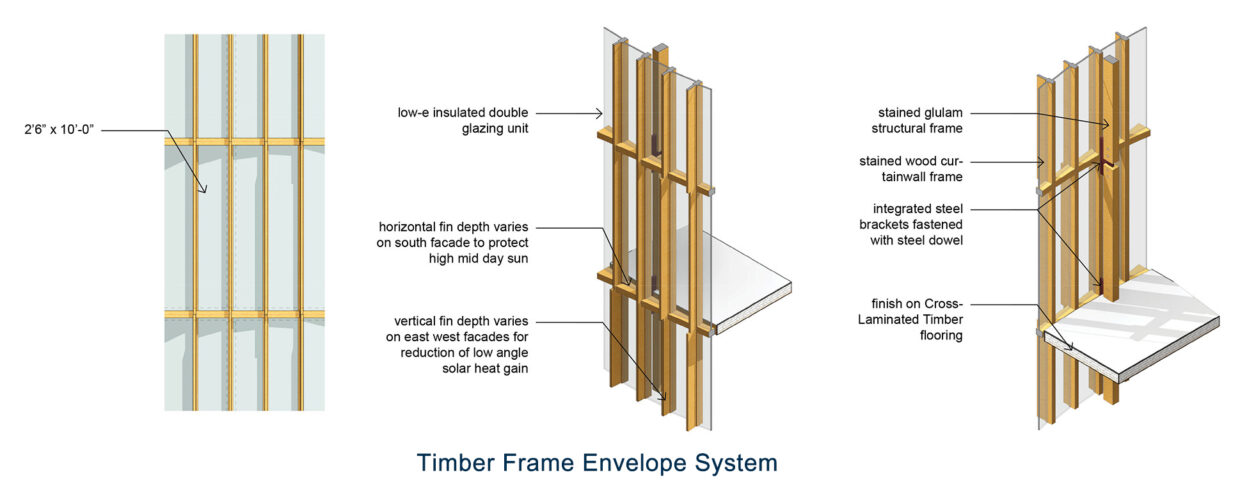
Our research focuses on contemporary wood construction as a sustainable, adaptable, and human-centered building system for public and institutional architecture. Grounded in professional practice and material-based inquiry, my work investigates how engineered timber systems, particularly glulam and CLT and mass timber assemblies, can advance environmental performance, occupant well-being, and architectural expression while remaining constructible and economically viable.
Drawing from extensive experience in institutional design and construction, we approach wood construction as both a technical and design-driven research topic. Our work examines timber systems through three key performance criteria: (1) material performance and constructability, including prefabrication strategies and BIM-driven workflows; (2) environmental and public health impacts, such as embodied carbon reduction, indoor environmental quality, and biophilic effects; and (3) architectural and spatial implications of timber systems in educational and civic buildings. This framework positions wood construction not only as a structural solution, but as an integrated architectural system that supports sustainability, wellness, and long-term resilience.
Methodologically, our research combines case-study analysis of built timber projects, detailed construction documentation, BIM-based modeling, and design experimentation. Professional practice serves as a critical research engine, allowing real-world constraints—codes, fabrication limits, coordination with consultants, and construction sequencing—to inform research questions and outcomes. Teaching studios and technical courses function as testing grounds where timber assemblies, detailing strategies, and hybrid systems are explored through iterative design and documentation.
A key component of our work is the investigation of how timber construction can support contemporary public architecture, particularly learning environments and institutional buildings that demand flexibility, durability, and a strong sense of place. Through both built projects and speculative design research, I explore how wood systems can enhance spatial quality, improve user experience, and contribute to healthier indoor environments while responding to climate-driven imperatives.
Moving forward, we plan to advance this research through peer-reviewed publications, conference presentations, and collaboration with industry partners involved in timber fabrication and construction. Future directions include comparative studies of international timber precedents, hybrid wood systems, and the role of timber construction in resilient educational infrastructure. Ultimately, our research seeks to contribute to the evolving discourse on wood construction as a responsible and expressive architectural system capable of shaping sustainable public architecture.